Ukrainians in Georgia deal with two parallel systems. The state pays for a defined list of services under a separate program for Ukrainian citizens: childbirth, dialysis, diabetes management, vaccination. Everything outside that list is out of pocket or through private insurance. Which of the two your case falls under decides whether you pay at all.
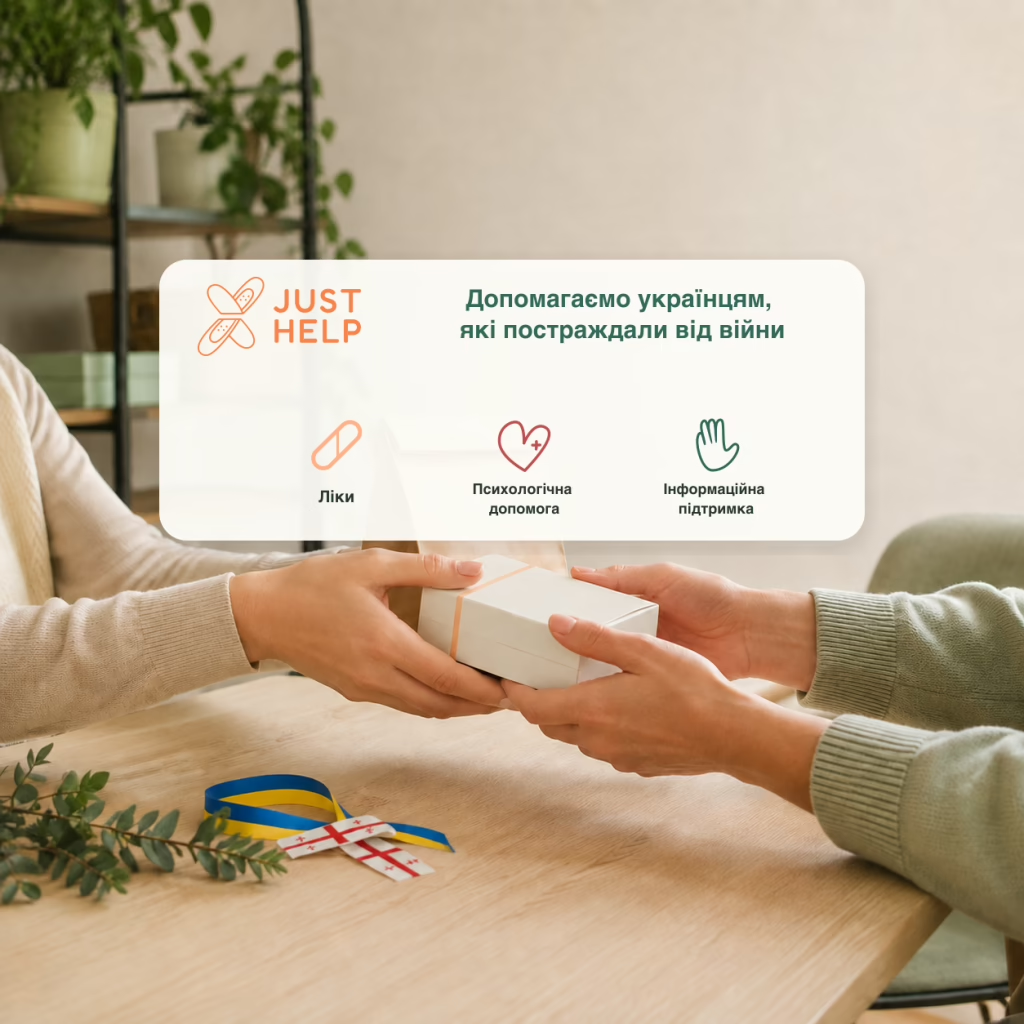
We built the medical part of this guide alongside the one published by Just Help, a nonprofit in Tbilisi that supplies Ukrainians with medicines and provides psychological and information support. The state program details were checked separately against Georgian government announcements and the Social Service Agency.
A word on geography first. The state program, the number 112, and the 1505 hotline work across all of Georgia — in Tbilisi, Batumi, Kutaisi, and the regions. Just Help's medicine support, though, is available in Tbilisi only, and doctor profiles on BigMed currently cover Tbilisi clinics. The text below flags which is which.
What Georgia pays for
The program covers Ukrainian citizens who entered Georgia on or after February 1, 2022, and have stayed in the country continuously since. The state covers:
emergency medical care, childbirth, and emergency immunization;
routine immunization;
treatment for tuberculosis and HIV/AIDS, including the specific medicines;
maternal and child health, including antenatal care and newborn screening;
psychiatric care;
diabetes management, including medicines;
dialysis;
treatment for rare diseases and for patients on continuous replacement therapy;
referral services: the mechanism through which the state funds individual procedures and operations on application.
Separately from the medical side, there are cash payments: 300 GEL per family toward housing and 45 GEL per person per month, paid through the Social Service Agency.
One detail makes this section worth rereading every couple of months. The government does not set the program open-ended. It renews it in steps, and the latest renewal runs until October 1, 2026. What happens after that date is not yet announced.
So before you count on a free service, confirm its current status with the Social Service Agency:
hotline: 1505;
info@ssa.gov.ge;
Tbilisi, 51 Ivane Javakhishvili Street.
If you fall outside the program (you arrived later, or you left the country), treatment is paid privately or through insurance.
In an emergency
Georgia's single emergency number is 112. It dispatches ambulances, police, and fire and rescue, and it works the same way for Georgian citizens, tourists, and anyone living here.
Call if someone loses consciousness, cannot breathe, is bleeding heavily, has a serious injury, or shows signs of a stroke or heart attack. Call for any condition that is getting worse fast.
Operators often speak Russian or English. If describing your location is hard, ask any local nearby to make the call. That is what the Just Help guide recommends, and the advice is sound.
Before anything happens, install the 112 Georgia app from Georgia's Ministry of Internal Affairs. You can enter your address and age in advance, and it has an SOS button and a chat. iOS · Android
Emergency care is part of the state program for Ukrainian citizens. Even if your case falls outside it, do not delay the call over money: make the call first, sort out insurance and payment afterward.
What happens after you call, what the operator asks, and how hospitals are assigned is covered in our own guide: Emergency Assistance in Georgia: How and When to Call 112.
When it is not an emergency
From there it works like any private healthcare market: you choose a clinic or a specific doctor and book yourself in. No referral from a district physician is required, and the price depends on the clinic and the specialty.
If you do not know who to see, start with a general practitioner. They examine you, order tests, and refer you onward when needed. It is the cheapest way to avoid paying three wrong specialists in a row.
General practitioners in Tbilisi, some of whom consult in Russian.
Pediatricians in Tbilisi, if the patient is a child.
Each profile shows the clinic, address, consultation price, and available times. A profile on BigMed does not mean the doctor treats patients under the state program for Ukrainian citizens. Confirm that with the clinic.
If you are in Batumi or another city, here is the honest position: our doctor profiles currently cover Tbilisi, as the full catalog shows. Locally, look for a multi-specialty clinic or medical center nearby and ask for a general practitioner. Your eligibility under the state program does not depend on the city: call 1505 from anywhere.
Insurance, when part of your care is already covered
The state program covers a fixed list of conditions. Anything outside it (an injury, appendicitis, planned surgery, a specialist consultation) is on you.
That is where private insurance comes in. What matters is not the price of the policy but:
coverage limits and what percentage of each service is paid;
the list of clinics the insurer has contracts with;
exclusions;
terms for chronic conditions;
waiting periods: some services only open up months after purchase;
the rules for claiming reimbursement.
There is an awkward overlap here. The conditions private insurers exclude most often (diabetes, HIV, psychiatric care, cancer that predates the policy) are largely the same ones the state program for Ukrainian citizens covers. That is not a coincidence: insurers built their products around Georgian residents, whose state already pays for those areas. The practical takeaway is simple. Check what is left uncovered by both systems at once.
If you have a chronic condition
Diabetes, dialysis, HIV, tuberculosis, rare diseases, and continuous replacement therapy are inside the state program. Start there, not with buying a policy. Call 1505 and find out what you are entitled to right now.
In parallel, check the practical side of your treatment:
whether your medicine is available in Georgia, and whether a local equivalent would be needed;
whether it requires a prescription;
whether a Georgian doctor has to be following you for it to be prescribed;
whether your insurance, if you have one, covers any of it.
Getting insured with an existing diagnosis is harder, and the rules differ between companies: Health Insurance for Pre-Existing Conditions.
If medicines have become unaffordable and your case falls outside the state program, that is exactly the situation Just Help works on.
Medicines through Just Help
Just Help is a nonprofit in Tbilisi that supplies Ukrainians with essential medicines, including cancer therapy, and medical supplies such as adult diapers. Between 150 and 200 people reach out every month. The team came out of Emigration for Action, a project that closed at the end of 2024, so they know the Georgian pharmacy market from the inside.
How it works:
You send a list of the medicines you need, with a doctor's prescription attached.
The project reviews the request and tells you what it can buy and what it cannot.
Once funding allows, the order goes to a pharmacy.
When the medicines are ready, you are notified: collect them at the distribution point or ask for delivery.
Reach them on Telegram, WhatsApp, or by phone at +995 551 512 700. The help is available to Ukrainians in Tbilisi.
Two limits the project states plainly about itself. Just Help is a charity, not a medical provider: a doctor makes the diagnosis and prescribes the treatment, and you need that prescription before you apply. And some requests cannot be filled, because the funding is finite.
Psychological support
Volunteer psychologists work with the project, running individual and group sessions for Ukrainians. Book through the same contacts: Telegram or +995 551 512 700.
Psychiatric care, on the other hand, is inside the state program. If the situation calls for a doctor rather than talk-based support, that is a separate route, and it starts with 1505.
What else is in the Just Help guide
Beyond direct assistance, the team maintains a large open guide for Ukrainians in Georgia. We used its medical section while preparing this article, and it holds things we do not publish: a list of 24-hour clinics in Tbilisi with map links, a price table by clinic, discounts for Ukrainians, and a breakdown of insurance companies.
The rest covers housing, bank accounts, transport, schools, residence permits, the Georgian language, and even what to do if a dog bites you. Arrived recently? Read the whole thing.
We have our own material on schooling and childcare in Georgia: how to enroll a child in school and vaccinations required for kindergarten. Routine childhood immunization is part of the state program. What is given and when is set out in our guide to childhood vaccination in 2026.
Keep these within reach
112: emergencies, plus the 112 Georgia app installed in advance.
1505: the Social Service Agency, for what you are entitled to now and how the payments work.
+995 551 512 700: Just Help, for medicines and psychological support in Tbilisi.
And what to store on your phone before you need it: a digital copy of your insurance policy, your insurer's contacts, a list of the medicines you take with their doses, and your recent medical records. The moment you need them, there is no time to look.
Supporting the project
Just Help buys medicines with donations. If you want that to continue, you can support the project once or monthly, by card, PayPal, Patreon, or Boosty: justhelp.charity/ua/support-us.
We thank the team for their work with Ukrainians in Georgia and for the open guide that saves people weeks of searching on their own.
This article is for general information and does not replace a consultation with a doctor. If life or health is at risk, call 112.
FAQ
Which Ukrainians in Georgia qualify for the state program?
Which medical services does the state pay for?
How long does the program run?
Do I still need insurance if the state covers part of my care?
How do I get medicines through Just Help?
Living in Georgia or planning to move here?
We write about doctors, treatment prices and health insurance in Georgia — in plain language.